
The laboratory of Actuarial and Financial Mathematics was established in 2002 and serves educational and research needs in the fields of Actuarial and Financial Science.
The aims of the laboratory are:
1. The coverage at undergraduate and postgraduate level of teaching and research needs on issues that fall within the objects of activity of the laboratory.
2. Cooperation of any kind with research centers and academic institutions, provided that the scientific objectives are in line with and complement those of the laboratory.
3. The organization of scientific lectures, workshops, seminars, symposia, conferences and other scientific events and the invitation of recognized scientists.
4. The provision of services to individuals.
5. Cooperation with Public Bodies, Organizations, Institutes and private companies in order to contribute to the study and solution of technological problems of the country.
WITH REGARD TO THE PRIMARY OBJECTIVE OF THE LABORATORY 'TO MEET THE TEACHING AND RESEARCH NEEDS AT UNDERGRADUATE AND POSTGRADUATE LEVEL ON SUBJECTS FALLING WITHIN THE SCOPE OF THE ACTIVITIES OF THE LABORATORY', THE FOLLOWING MATERIAL IS PROVIDED.
Two recent publications of practical interest as well as a Research Project
Notes on related courses (in greek)
Book to be published
As one can easily see by studying the above papers (and corresponding notes), the proper purchase and sale of options greatly improves the effectiveness of the portfolio that contains them. In the case in which such contracts are not available on the market, then portfolio construction results in the application of Markowitz's theory, so the above theory is a generalization of Markowitz's theory (see problem (9) of slides Financial Mathematics I).
Often, entire semester courses and entire books (even recent ones) are spent on pricing problem of options and not on their proper implementation, resulting in students not being able to use them appropriately. Regarding the valuation of these contracts, it should be made clear that in practice their prices arise according to the law of supply and demand but also the presence of arbitrage. Therefore, all we can theoretically do is calculate the arbitrage free price interval (solving problems (10) and (11) of the notes) in order to have an order of magnitude of the value of this contract. Thus, the corresponding valuation theories do not (and never will) result in a selling price that will eventually appear on the market and therefore have no practical interest. One argument in favor of the above conclusion is that because the values of options depend on the underlying shares, it is impossible to predict their value without first predicting the price of the underlying.
Markowitz's theory does not take into account available options and therefore does not carry out a transfer of risk, so one is obliged to measure risk (Value at Risk) rather than manage it. However, risk measurement does not lead to static results because the market is dynamic and therefore the next day the corresponding quantity can change drastically. But risk management is something static and objective and is exactly what investors prefer. In full correspondence, in Actuarial and Insurance science, risk transfer is done through the concept of reinsurance. Therefore, a professional should know the available ways of risk transfer and through solving an optimization problem to come up with the appropriate strategy for him.
Our goal is to develop software of practical interest which we will list here.
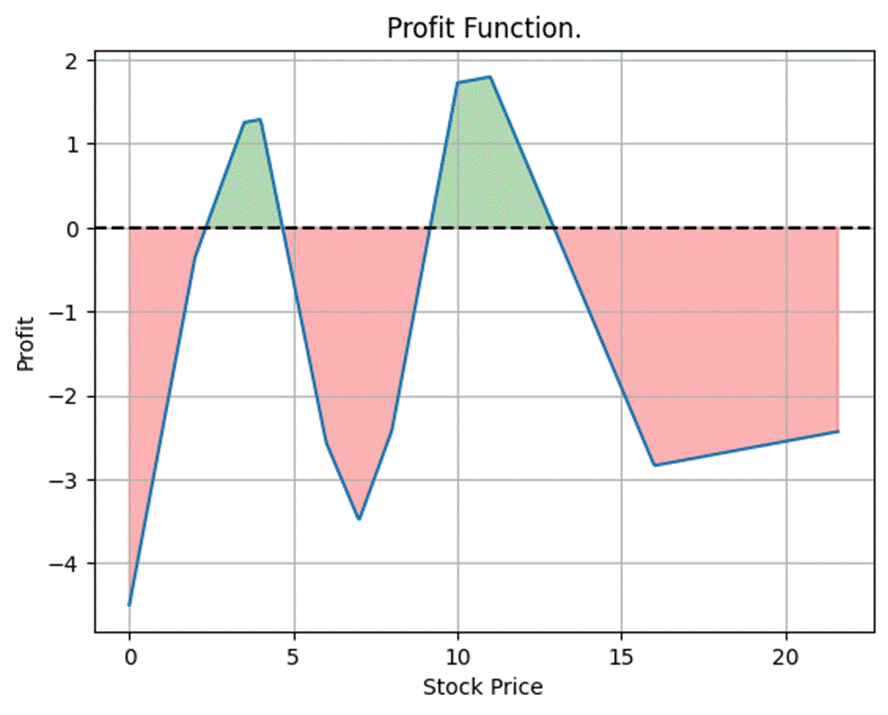
· Given a prediction of where a stock's value will be, by equipping our portfolio with suitable call and put options, we can construct a portfolio that will yield a profit if the prediction is confirmed. See the figure below. For this purpose, appropriate predictive software that also considers recent events would be particularly useful. This figure was generated using real data (bid-ask spread) with this Python code. In this file, you will also find the corresponding code that identifies, if available, an opportunity for sure profit given a stock and its call and put options..
· Regarding the option pricing problem, one can use the two Python codes at the same zip file above. With these two codes, we can calculate the no-arbitrage interval for the value of a contract with a payoff function f(x) which is provided by the user. This function must be piecewise linear with a finite number of segments. In this code, we use real data (bid-ask spread), and it can be applied in practice for pricing any derivative written on a stock, in contrast to well-known pricing models like Black-Scholes, Binomial, etc. One can test the pricing of a simple call option, given that other call and put options exist in the market, both with the aforementioned technique and with the known pricing techniques.
What ultimately makes practical sense to study next is to apply the above to portfolios that contain multiple stocks along with options, and also to develop forecasting techniques that are not based solely on historical data but also on recent events.
Stochastic Differential Equations
For the numerical solution of stochastic differential equations whose exact solution possesses specific properties, e.g., positivity, we have proposed the so-called semi-discrete method (see, for example, https://www.degruyterbrill.com/document/doi/10.1515/mcma-2016-0113/html and the references therein). For a comparison with other methods, one can consult the recent work https://link.springer.com/article/10.1007/s11075-025-02096-8.
Useful Links
1. Hellenic Association of Actuaries
2. State Scholarships Foundation
4. European Finance Association (EFA)
5. Funding opportunities in research and innovation
6. 10 websites you need to know for European funding opportunities