
Research, Notes, Slides & Publications
The Actuarial-Financial Mathematics Lab supports undergraduate and postgraduate teaching and research in financial mathematics, stochastic processes, portfolio theory, derivative pricing, actuarial modelling, and computational methods.
Core Research Programme
Option Pricing through Feasible Hedging
Our central research question is deliberately operational: which option prices can be justified by hedging actions that can actually be executed? Instead of beginning with an idealized pricing formula and asking afterwards whether the associated hedge is realistic, we begin with the market actions that are genuinely available and let those actions determine what can be certified.
1. Certification
Determine the prices that are compatible with the declared feasible hedging technology. The resulting bounds are tied to explicit trading actions, not to a probability measure alone.
2. Price Selection
Once the feasible region is known, a deterministic or probabilistic criterion may be used to choose a reference or fair price inside that region.
3. Market Price Formation
The actual transaction price is a different object. It is formed through supply and demand, liquidity, order flow, inventory, market sentiment, and other market forces.
Why Feasibility Comes First
Classical option-pricing theory established the deep connection between valuation, hedging, and no-arbitrage. Black–Scholes–Merton demonstrated this connection through continuous-time replication, while Cox–Ross–Rubinstein made the replication logic transparent in discrete time. These theories remain fundamental.
The feasible-hedging viewpoint asks a different question: what survives when the hedging technology is required to reflect the transactions that an investor can actually perform? Trading may occur only at specified times; bid–ask prices may differ; market depth may be finite; positions may be restricted; contracts may have integer lots; short selling or borrowing may be limited; and American options carry exercise rights that are intrinsically asymmetric.
For this reason, the strategy class itself is treated as an economic input of the pricing problem. Static, semi-static, and finite-grid dynamic hedging are not interchangeable abstractions: they are different executable technologies and may therefore certify different price intervals.
- More feasible hedging opportunities can only improve deterministic certification.
- More restrictive path information can tighten the range of paths that must be protected.
- Bid–ask spreads, depth, lot sizes, and trading restrictions belong inside the pricing problem rather than being added only afterwards.
- No probability measure is required for the basic deterministic certification step.
Certification Is Not Prediction
A stochastic model, a risk-neutral measure, a physical probability law, a CVaR criterion, or a machine-learning model can be extremely useful for valuation, forecasting, or for choosing among feasible hedges. But a probabilistic transformation is not itself a market transaction.
Therefore, a model-generated price does not acquire a feasible-hedging arbitrage interpretation merely because it comes from a mathematically consistent model. That interpretation comes from an executable hedge or from an independent deterministic certificate under the declared market protocol.
This distinction is especially important when theoretical hedging requires continuous rebalancing, unlimited liquidity, frictionless trading, unrestricted borrowing or short selling, or other actions that are not available in the actual market. In such cases the model may still be valuable, but its price should not be confused with a same-market executable arbitrage certificate.
Deterministic Arbitrage and Bilateral Fairness
The framework uses deterministic, pathwise arbitrage restrictions. A feasible zero-cost strategy that is nonnegative on every admissible path and strictly positive on at least one path provides a hard price restriction that does not depend on a predictive probability law.
Writer-side and buyer-side feasible hedges generate lower and upper certification values. Their difference is the feasibility gap: the amount of bilateral worst-case burden left unresolved by the currently available hedge technology.
Changing the transaction price only reallocates this burden between buyer and writer. Improving the feasible hedging technology can reduce the gap itself. The midpoint of the certified interval has a natural bilateral interpretation: it is the unique price that equalizes the two optimized worst-case burdens.
This perspective does not aim to replace classical, robust, or probabilistic option pricing. Its purpose is to make the strategy class visible and to distinguish clearly between what is certified by executable hedging, what is selected by a model or risk criterion, and what is ultimately traded in the market.
Slides and Additional Material
Selected slides and supplementary educational resources are available below.
Financial Engineering: The Big Picture
Financial Slides
Slides on Portfolio Construction
Financial Engineering
Slides on Arbitrage
Dynamic Trading Strategies
Forecasting Asset Prices
Machine Learning or Modelling
Books
Selected books related to the scientific and educational activities of the laboratory.
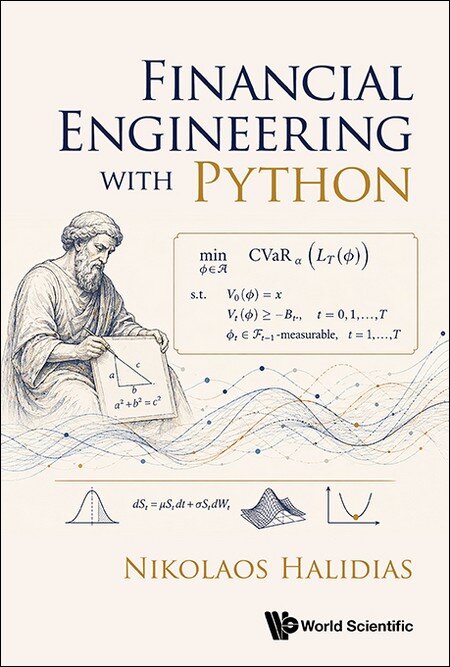

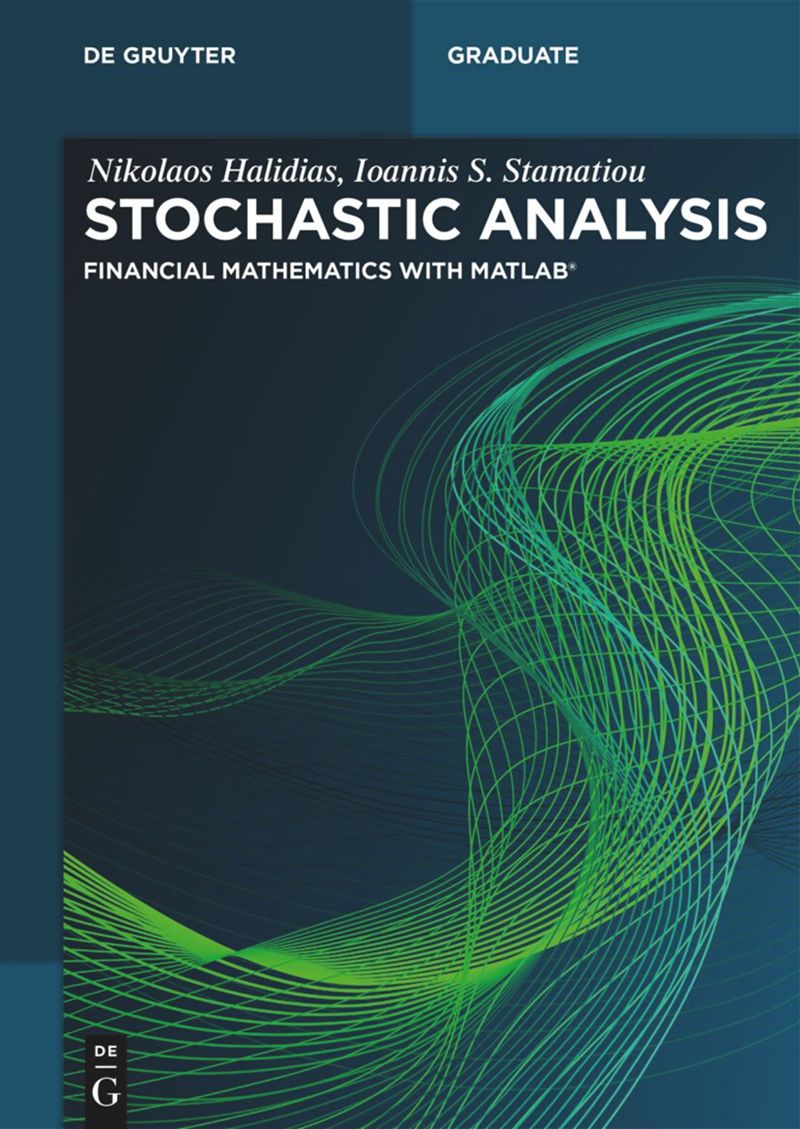

Publications on ResearchGate
The laboratory's publications, preprints, books, slides, code material, and related research output are available on ResearchGate.
Stochastic Differential Equations
For the numerical solution of stochastic differential equations whose exact solutions satisfy qualitative properties such as positivity (as occurs, for example, in models for asset prices), we have proposed the so-called semi-discrete method. For further details, see Monte Carlo Methods and Applications, together with the references therein. For a recent comparison with other numerical methods in a stochastic model arising in biology, see Numerical Algorithms.
For additional information regarding current research directions, publications, and educational material, please contact the laboratory team.